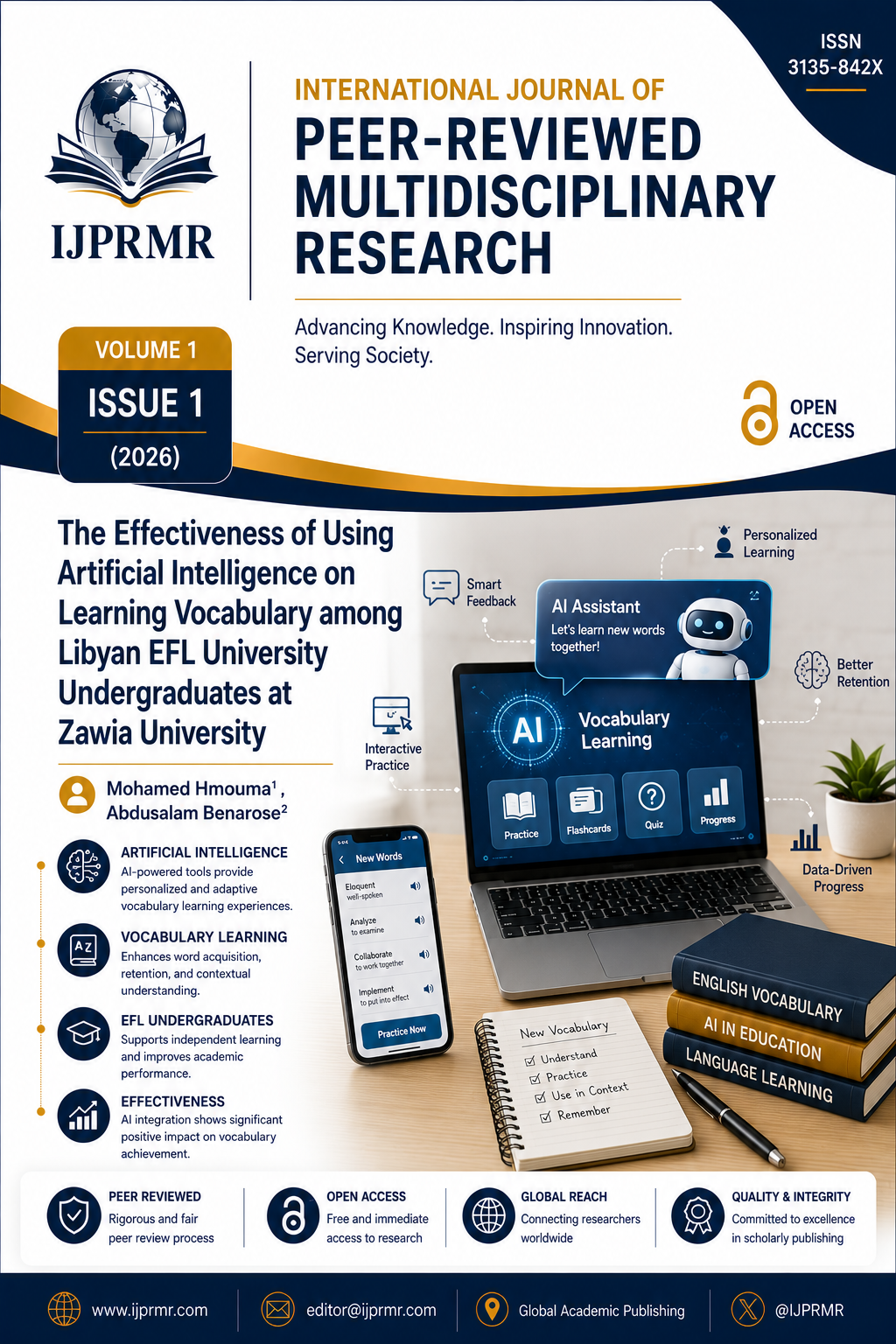
The Effectiveness of Using Artificial Intelligence on Learning Vocabulary among LibyanEFL University Undergraduates at Zawia University
الملخص
This study investigates the effectiveness of using artificial intelligence (AI) in enhancing vocabulary learning among Libyan EFL undergraduate students at Zawia University. The research adopts a quasi-experimental design involving an experimental group exposed to AI-based vocabulary learning tools and a control group taught through traditional methods. Data were collected using pre-test and post-test instruments to measure vocabulary acquisition. Statistical analysis revealed a significant improvement in the experimental group compared to the control group. The findings suggest that AI-based learning environments provide interactive, adaptive, and personalized learning experiences that enhance vocabulary retention and usage. The study concludes that AI integration in EFL classrooms significantly improves vocabulary learning outcomes and recommends its incorporation into higher education curricula in Libya.
الكلمات المفتاحية
Artificial Intelligence، Vocabulary Learning، EFL، Libya، Language Technology
المراجع
- Chapelle, Carol A. (2001). Computer applications in second language acquisition. Cambridge University Press.
- Chen, X., Chen, T., & Lin, C. (2020). The effectiveness of AI-based vocabulary learning systems. Computers & Education, 150, 103842. https://doi.org/10.1016/j.compedu.2020.103842
- Creswell, John W. (2014). Educational research: Planning, conducting, and evaluating quantitative and qualitative research (4th ed.). Pearson.
- Holmes, Wayne, Bialik, Maya, & Fadel, Charles. (2019). Artificial intelligence in education: Promises and implications for teaching and learning. Center for Curriculum Redesign.
- Hmouma, M. (2014). Interlanguage syntax of the noun phrase in English: An error analysis of third-year secondary students in Zawia, Libya. IOSR Journal of Humanities and Social Science, 19(5), 36–43. https://doi.org/10.9790/0837-19543643
- Hmouma, M. (2024). Exploring Libyan EFL undergraduates’ attitudes towards AI-driven English learning applications. University of Zawia Journal of Educational and Psychological Sciences (UZJEPS), 13(2), 473–486. https://journals.zu.edu.ly/index.php/UZJEPS/article/view/1064
- Li, Jian. (2021). The role of AI chatbots in vocabulary acquisition. Language Learning & Technology, 25(3), 45–63.
- Mayer, Richard E. (2009). Multimedia learning (2nd ed.). Cambridge University Press.
- Nation, I. S. Paul. (2001). Learning vocabulary in another language. Cambridge University Press.
- Russell, Stuart, & Norvig, Peter. (2021). Artificial intelligence: A modern approach (4th ed.). Pearson.
- Schmitt, Norbert. (2000). Vocabulary in language teaching. Cambridge University Press.
- Vygotsky, Lev. (1978). Mind in society. Harvard University Press.