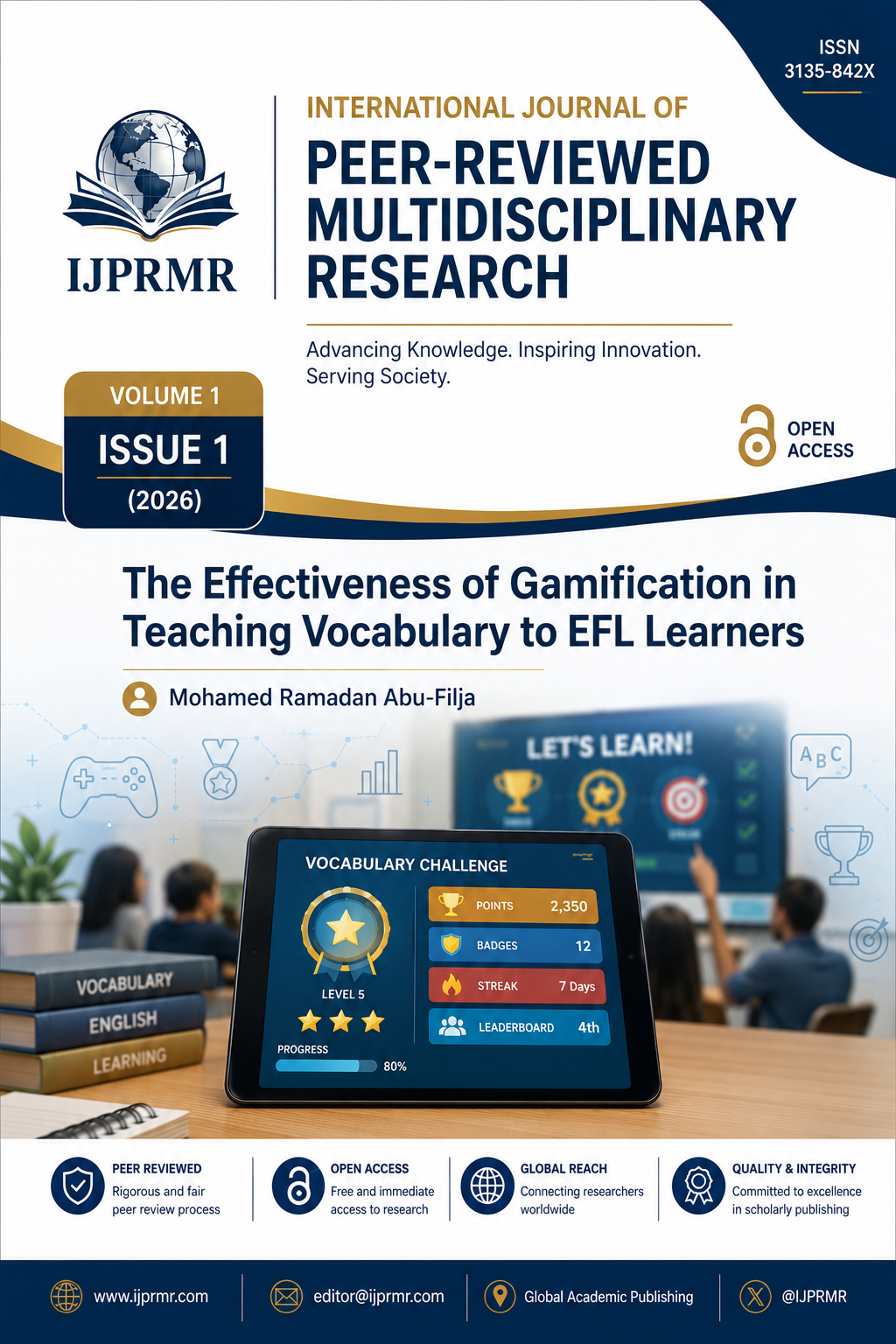
The Effectiveness of Gamification in Teaching Vocabulary to EFL Learners
الملخص
Vocabulary acquisition plays a fundamental role in second language learning, as it enables learners to comprehend texts, communicate effectively, and participate in meaningful interactions. However, many English as a Foreign Language (EFL) learners struggle to retain new vocabulary due to traditional teaching methods that rely heavily on memorization and repetitive exercises. Gamification, which involves integrating game elements such as points, badges, leaderboards, and challenges into educational contexts, has emerged as an innovative strategy to increase learners’ motivation and engagement. This study explores the effectiveness of gamification in teaching vocabulary to EFL learners through a qualitative literature review approach. The findings indicate that gamified learning environments enhance student engagement, improve vocabulary retention, and promote active participation in language learning activities. The results also highlight the importance of aligning game mechanics with pedagogical objectives to maximize learning outcomes. The study suggests that incorporating gamification into vocabulary instruction can significantly contribute to improving EFL learners’ motivation and vocabulary acquisition.
الكلمات المفتاحية
gamification، vocabulary learning، EFL learners، language teaching، game-based learning
المراجع
- Chen, H. J., & Yang, T. Y. (2013). The impact of adventure video games on foreign language learning
- and the perceptions of learners. Interactive Learning Environments, 21(2), 129-141.
- Deci, E. L., & Ryan, R. M. (2000). The "what" and "why" of goal pursuits: Human needs and the selfdetermination of behavior. Psychological Inquiry, 11(4), 227-268.
- Deterding, S., Dixon, D., Khaled, R., & Nacke, L. (2011). From game design elements to gamefulness:
- Defining "gamification". Proceedings of the 15th International Academic MindTrek Conference:
- Envisioning Future Media Environments, 9-15.
- Folse, K. S. (2004). Vocabulary myths: Applying second language research to classroom teaching.
- University of Michigan Press.
- Gee, J. P. (2003). What video games have to teach us about learning and literacy. Palgrave Macmillan.
- Hamari, J., Koivisto, J., & Sarsa, H. (2014). Does gamification work? A literature review of empirical
- studies on gamification. 2014 47th Hawaii International Conference on System Sciences, 3025-
- 3034.
- Hung, H. T., Chang, J. L., & Yeh, H. C. (2018). A review of trends in digital game-based language
- learning research. Journal of Educational Technology & Society, 21(3), 78-90.
- Hwang, G. J., Wu, P. H., & Chen, C. C. (2016). An online game approach for improving students'
- learning performance in web-based problem-solving activities. Computers & Education, 59(4),
- 1246-1256.
- Kapp, K. M. (2012). The gamification of learning and instruction: Game-based methods and strategies
- for training and education. Pfeiffer.
- Landers, R. N., & Landers, A. K. (2014). An empirical test of the theory of gamified learning: The effect
- of leaderboards on time-on-task and academic performance. Simulation & Gaming, 45(6), 769-
- 785.
- Nation, I. S. P. (2001). Learning vocabulary in another language. Cambridge University Press.
- Nation, I. S. P. (2013). Learning vocabulary in another language (2nd ed.). Cambridge University Press.
- Oxford, R. L., & Scarcella, R. C. (1994). Second language vocabulary learning among adults: State of the
- art in vocabulary instruction. System, 22(2), 231-243.
- Reinders, H., & Wattana, S. (2014). Can I say something? The effects of digital game play on willingness
- to communicate. Language Learning & Technology, 18(2), 101-123.
- Schmitt, N. (2008). Instructed second language vocabulary learning. Language Teaching Research, 12(3),
- 329-363.
- Schmitt, N. (2010). Researching vocabulary: A vocabulary research manual. Palgrave Macmillan.
- Smith, G. G., Li, M., Drobisz, J., Park, H. R., Kim, D., & Smith, S. D. (2013). Play games or study?
- Computer games in eBooks to learn English vocabulary. Computers & Education, 69, 274-286.
- Werbach, K., & Hunter, D. (2012). For the win: How game thinking can revolutionize your business.
- Wharton Digital Press.
- Yip, F. W., & Kwan, A. C. (2006). Online vocabulary games as a tool for teaching and learning English
- vocabulary. Educational Media International, 43(3), 233-249.