The Impact of Classroom Seating Arrangements on Student Engagement in EFLClassrooms: A Case Study at a Libyan Preparatory School
Abstract
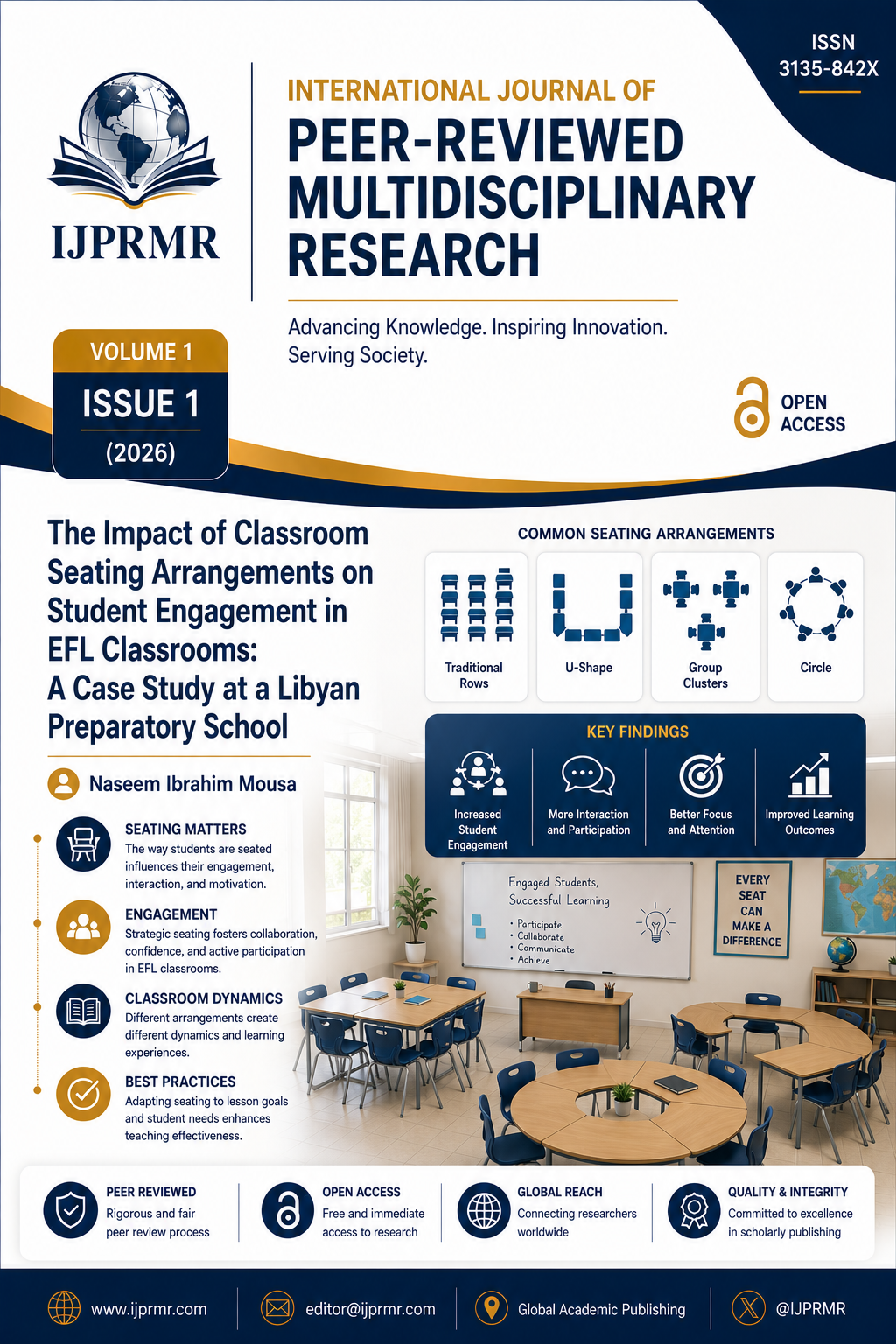
This study employs a case study design to provide an in-depth understanding of the impact of classroom seating arrangements on EFL students’ engagement. Grounded in engagement theory and communicative language teaching, the study employs an explanatory mixed-methods approach, where quantitative data were collected using structured classroom observations, followed by qualitative data from a semistructured teacher interview to explain the observed patterns. The study focuses on a single ninth-grade EFL classroom consisting of 30 students taught by one teacher under two different seating arrangements: traditional row seating and cluster group seating. Quantitative data were gathered using time-sampling techniques to measure on-task behavior, while qualitative data explored the teacher’s perceptions of engagement, feasibility and classroom management. The findings indicated that while row seating supported initial behavioral control, cluster resulted in with higher levels of student engagement, although practical constraints such as classroom space and furniture limited its consistent implementation. The study stressed the importance of aligning classroom organization with pedagogical goals and contextual realities.
Keywords
classroom environment, seating arrangements, student engagement, EFL, Libya
References
- Alrabai, F. (2016). The effects of teachers’ in-class motivational intervention on learners’ EFL achievement. Applied Linguistics, 37(3), 307–333. https://doi.org/10.1093/applin/amu021
- Bakeman, R., & Gottman, J. M. (1997). Observing interaction: An introduction to sequential analysis (2nd ed.). Cambridge University Press.
- Barrett, P., Davies, F., Zhang, Y., & Barrett, L. (2015). The impact of classroom design on pupils’ learning: Final results of a holistic, multi-level analysis. Building and Environment, 89, 118–133.
- https://doi.org/10.1016/j.buildenv.2015.02.013
- Brooks, D. C. (2011). Space and consequences: The impact of different formal learning spaces on instructor and student behavior. Journal of Learning Spaces, 1(2), 1–24.
- Byers, T., Imms, W., & Hartnell-Young, E. (2014). Making the case for space: The effect of learning spaces on teaching and learning. Curriculum and Teaching, 29(1), 5–19.
- Cheryan, S., Ziegler, S. A., Plaut, V. C., & Meltzoff, A. N. (2014). Designing classrooms to maximize student achievement. Policy Insights from the Behavioral and Brain Sciences, 1(1), 4–12. https://doi.org/10.1177/2372732214548677
- Creswell, J. W., & Creswell, J. D. (2018). Research design: Qualitative, quantitative, and mixed methods approaches (5th ed.). Sage publications.
- Creswell, J. W., & Plano Clark, V. L. (2018). Designing and conducting mixed methods research (3rd ed.). Sage.
- Evnitskaya, N., & Berger, E. (2017). Learners’ multimodal displays of willingness to participate in classroom interaction in the L2 and CLIL contexts. Classroom Discourse, 8(1), 71-94.
- Fernandes, A. C., Huang, J., & Rinaldo, V. J. (2011). Does where a student sits really matter? Teaching and Learning Inquiry, 1(1), 66–77.
- Fredricks, J. A., Blumenfeld, P. C., & Paris, A. H. (2004). School engagement: Potential of the concept. Review of Educational Research, 74(1), 59–109.
- Fredricks, J. A., & McColskey, W. (2012). The measurement of student engagement. In S. L. Christenson et al. (Eds.), Handbook of research on student engagement (pp. 763–782). Springer.
- Kirkpatrick, A. (2012). English as an international language in Asia. Englishes in Practice, 1(1), 4–15.
- Marx, A., Fuhrer, U., & Hartig, T. (1999). Effects of classroom seating arrangements on children’s question-asking. Learning Environments Research, 2(3), 249–263. https://doi.org/10.1023/A:1009901922191
- Reschly, A. L., & Christenson, S. L. (2012). Jingle, jangle, and conceptual haziness: Evolution and future directions of the engagement construct. In S. Christenson et al. (Eds.), Handbook of research on student engagement. Springer.
- Rosenfield, P., Lambert, N. M., & Black, A. (1985). Desk arrangement effects on pupil classroom behavior. Journal of Educational Psychology, 77(1), 101–108.
- Sato, M. (2017). Interaction mindsets, interactional behaviors, and L2 development. Language Teaching Research, 21(3), 1–21.
- Skinner, E. A., & Pitzer, J. R. (2012). Developmental dynamics of engagement. In S. Christenson et al. (Eds.), Handbook of research on student engagement. Springer.
- Storch, N. (2013). Collaborative writing in L2 classrooms. Multilingual Matters.
- Wang, M. T., Fredricks, J., Ye, F., Hofkens, T., & Linn, J. (2017). The math and science engagement scales. Learning and Instruction, 43, 16–26.
- Wannarka, R., & Ruhl, K. (2008). Seating arrangements that promote positive academic behavior. Support for Learning, 23(2), 89–93.
- Wedell, M., & Malderez, A. (2013). Understanding language classroom contexts. Bloomsbury.
- Weinstein, C. S. (1979). The physical environment of the school. Review of Educational Research, 49(4), 577–610.
- Yin, R. K. (2018). Case study research and applications (6th ed.). Sage.
- Zarrinabadi, N., & Tanbakooei, N. (2016). Willingness to communicate. System, 62, 27–38.